Exhaust Gas Recirculation
Motivation
Exhaust Gas Recirculation (EGR) is a nitrogen oxide (NOx) reduction technique used in internal combustion engines. The system works by recirculating a portion of the engine’s exhaust gas back into the combustion chamber, where it mixes with the incoming fresh air-fuel mixture. This seemingly counterintuitive approach of mixing “waste” exhaust gases with fresh intake air serves a crucial purpose in modern automotive engineering.
Objectives
The objectives for this tutorial are as follows:
- Create a three-dimensional mesh in OpenFOAM with
cartesianMeshand check its quality, - Set boundary conditions,
- Run a transient, compressible simulation with
rhoPimpleFoamin parallel, - Plot the maximum and average temperature at the outlet,
- Visualize the velocity field in ParaView, and
- Vary flow rate of exhaust gas and analyse impact onto flow field.
Overview
This tutorial will describe how to pre-process, run, and post-process a case involving a transient, compressible flow of a exhaust gas recirculation. The geometry is shown in the following figure with an inlet for cold air on the left, inlet for the hot exhaust gas in the center, no-slip adiabatic walls for the air and exhaust side, and an outlet at the right. The flow will be solved using the OpenFOAM solver rhoPimpleFoam the suitable for laminar and turbulent, compressible, transient flows.
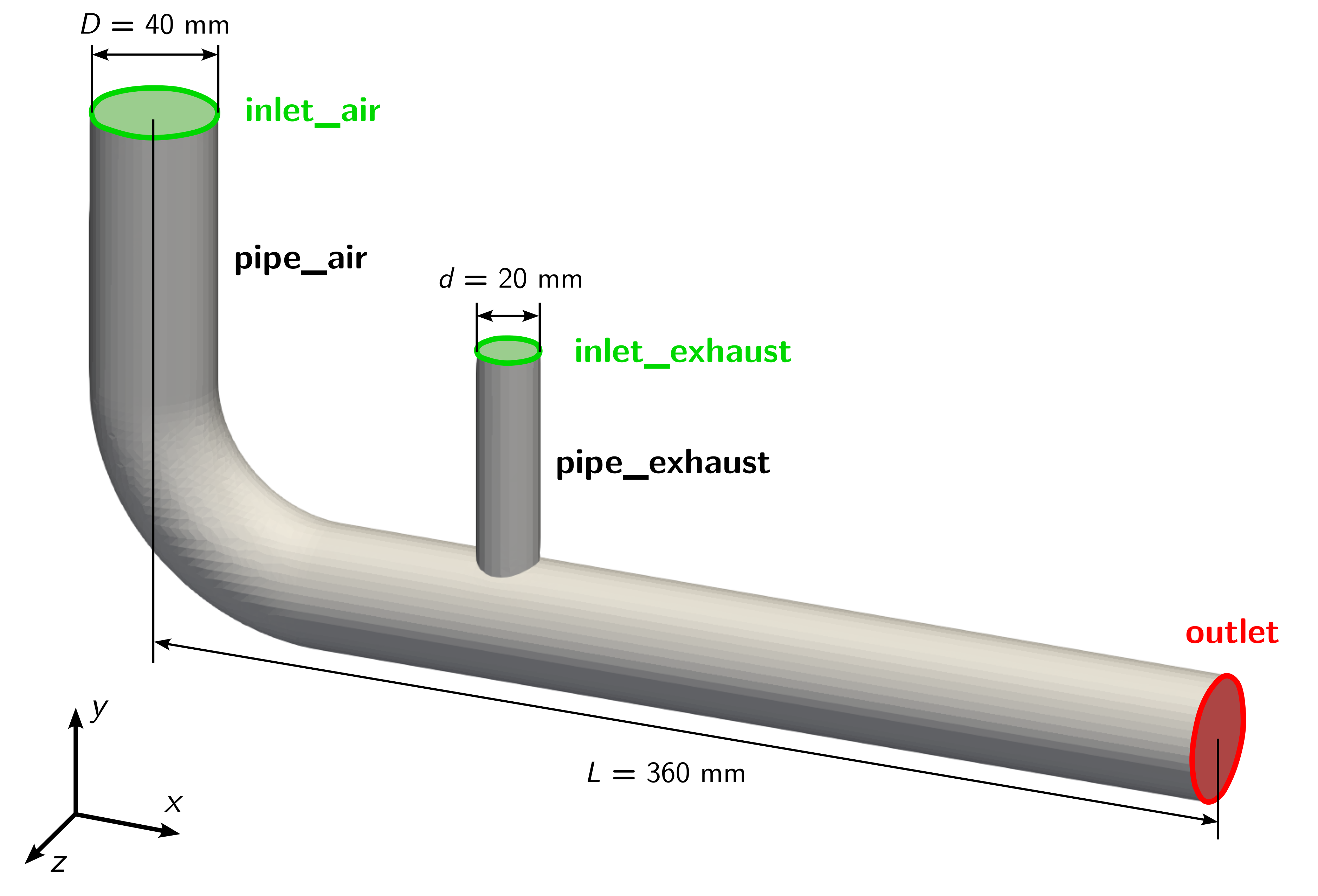
The boundary conditions for the give problem are as follows:
- Air inlet: Volumetric flow rate of \(Q = 0.005\,\text{m}^3\text{/s}\) at a temperature of \(300\,\text{K}\)
- Exhaust gas inlet: Volumetric flow rate of \(Q = 0.0025\,\text{m}^3\text{/s}\) at a temperature of \(900\,\text{K}\)
- Outlet: Pressure of \(10^5\,\text{Pa}\)
- Pipe walls: Adiabatic and no-slip
Due to the high temperature differences between air and exhaust gas, the flow is assumbed to be compressible.
Preparation
Before starting, perform the following steps for preparation:
- Download the archive
6_exhaust_gas_recirculation.zipfrom the Downloads folder on the OPAL course page. - Extract the archive.
- Open a terminal, navigate to the newly created folder, and source OpenFOAM.